

CONSTANT CRISIS
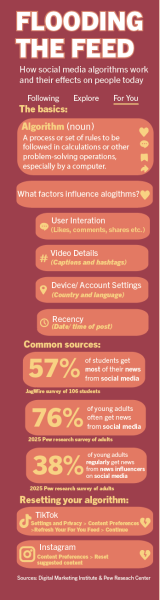
Whether it’s reading the nightly local news, watching CNN 10 in class or a five second TikTok clip, teens are constantly being flooded with current events and news. This overwhelming and constant consumption of content can make students feel hopeless about the state of the world.
According to Pew Research Center, people generally feel more negative emotions when watching the news. 43% of people sometimes feel sad and 39% sometimes feel scared.
The news often highlights negative events such as violence involving immigration or conflicts in Palestine and Ukraine. Sometimes seeing this overflow of negative content can impact students’ mental health. Junior Taleen Elkhatib feels the negativity can get to her.
“I definitely do feel hopelessness whenever I read about Palestine and other things going on in the world, but I also see how Palestinians’ belief in God is very strong, so I try to think the same way,” Elkhatib said.
The American Psychological Association examined this issue, reporting that overconsumption of news, especially negative events, can negatively impact people’s mental health. This intake of news can make people feel overwhelmed or anxious about the future.
The National Institute of Health found that news can affect people’s mood and one study even found that sadness and worries increased after being exposed to negative news reports.
Similarly to Elkhatib, senior Jordan Powell has felt these effects when watching negative news content on social media.
“Sometimes, a TikTok will get me a few times, and I might be pretty sad for the rest of the day,” Powell said. “But most of the time, I do it more to be informed, as opposed to having an extreme emotional reaction.”
Social studies teacher Chris McAfee also believes that a lot of the negativity and hopelessness about current events can come from the sheer amount of content there is for students to consume on social media, and even simply at the school.
“It is hard for students to process a lot of [current events], because it’s getting harder and harder to know what’s real and they are so overwhelmed,” McAfee said. “And so there’s a lot of distractions, both within school and technology life and it’s just overwhelming.”
BECOMING DESENSITIZED
According to Pew Research, young people are more likely to say the news they get makes them feel scared or confused, with 33% saying news makes them feel each of these emotions often. With this rise in extreme emotion, people have started to become desensitized to the news.
Through this constant roll out of news, students like Elkhatib have recently seen the news leaning more negatively.
“[The news] has become more violent,” Elkhatib said. “Social media does play a big role, I look at the comment sections and they’re also very negative. There’s just a lot of violence going on in the world right now.”
Powell doesn’t see herself losing empathy for the situations she sees, even with the same situation being continually run, losing its emphasis.
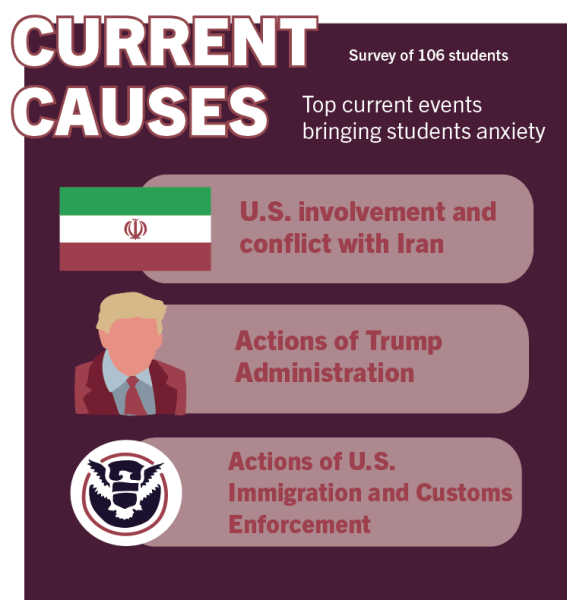
“I know it’s easy to get desensitized to major issues or things you hear over and over again, like what’s happening with ice in Minnesota, or the protests in Iran,” Powell said. “It’s hard to take in so much information and then keep feeling the same amount of emphasis or the amount of emotion as you did when you first read about it, but I do think that the stories change so much and that so many updates happen with every major issue that it’s hard to lose empathy for it.”
McAfee thinks that overconsuming news can be a danger within itself that students need to be aware of.
“[News consumption] gets to a point where it’s raising your anxiety levels,” McAfee said. “I definitely have friends who live in their news bubble, and they’re so worked up all the time. It’s important to be informed, but also not get yourself worked up, allow yourself time to still go and have a life and do other things.”
McAfee has also seen the news change over the years and become more biased, making it harder to get cold hard facts and form an original opinion.
“Big news agencies have become more more opinionated, but it’s passed off as news, and so it’s really hard for people sometimes to find actual facts, because a lot of this is trying to sway your opinion or trying to catch your attention,” McAfee said. “ So unfortunately, on the big news sites you don’t necessarily get news.”
INCREASED ACCESSIBILITY
With the rapid expansion of the internet, it has become increasingly difficult to avoid the relentless flow of news and information. Online platforms and social media feeds update constantly, and while this accessibility can keep teens informed and connected, it can also be a cause of overwhelming stress.
According to the Reuters Institute, more than half of people get their news from networks like Facebook, X and Youtube, overtaking TV, news sites and apps. News coverage is becoming more readily available at just the touch of a button.
With so many stories being exposed to teens at the constant rate at which the world is changing, McAfee thinks it can be easy for teens to disregard information or be unable to keep up with it all.
“There’s so much information at our fingertips,” McAfee said. “There’s no real easy way to sort through what’s real, what’s not real, what’s an opinion, what’s a fact, what’s misleading and what’s not, soI think a lot of students don’t even bother to follow.”
With the wide availability for news distribution, misinformation and opinionated coverage can be spread just as easily and be disguised as factual knowledge. McAfee believes social media has made a great impact on the news industry.
“Especially with the advent of the internet and social media, the big news agencies have become more opinionated,” McAfee said. “So unfortunately, on the big news sites you don’t necessarily get news. You get the things that elicit emotions, but not necessarily things that bring about a more informed citizen both of our country.”
Scrolling online, Elkhatib sees sides of important events that news stations don’t cover.
“A lot of social media platforms will get unreleased footage and a lot of the videos that we see on social media are more negative,” Elkhatib said. “Like with ICE and the Renee Good situation, I saw a lot of videos that weren’t aired on news stations and they were more violent, so a lot of the comments were really negative.”
With the constant stream of negative news coverage, sophomore Alexander Rocha believes that teens may feel inclined to step away from reliable sources and opt for more appealing content online.
“On social media, like Instagram, Tiktok or Facebook, you can see all these nice little videos of the wholesome moments in bad areas,” Rocha said. “But if you look out in the news and articles, it’s always showing the negative side of it.”
MAKING A DIFFERENCE
According to Scientific American, researchers recommend a variety of mechanisms for coping with fear-inducing news.
McAfee encourages reflection as the first step to overcoming these feelings.
“Getting to the root of what’s causing somebody to feel in that way can be informative, and then they can change their news-consuming habits,” McAfee said. “They can change what they’re following online.”
Recognizing that there is a massive amount of upsetting news available, Powell attempts to follow more palatable stories.
“I try to also take in information that might be a little bit more positive,” Powell said. “There’s still plenty of progress that is happening across the world, with many major regions like climate change or issues like that are still important to read about, to have some hope, but most things are pretty negative, and that does kind of hurt a little bit.”
Some students, like Elkhatib, cope by using what they learn to advocate for change and educate their peers.
“[Being updated on news] makes me feel thankful, but also it makes me feel like it’s my duty to be made aware of current events and talk to people and have conversations about this stuff,” Elkhatib said. “I have conversations with my friends and family all the time about ICE and wars going on.”

Called to action by feelings of discontent, Elkhatib and others who want to make their voices heard participate in activism.
“I try to go to protests regularly, especially for Palestine,” Elkhatib said. “They have a lot in the Plaza, so I go down there and just protest for a bit. I also repost on social media, a lot of things on Instagram, I repost about ICE and Palestine.”
Even though common advice is to stop watching the news, freshman Ethan Jennings believes we need to remain informed. However, finding a way to sit with it is necessary.
“If you think [too much] about all these wars going on, then what you think will be ‘The world’s a bad place, and nothing can get better’,” Jennings said. “We can still listen to it, but we should focus on what we could do and how we can make it possible.”
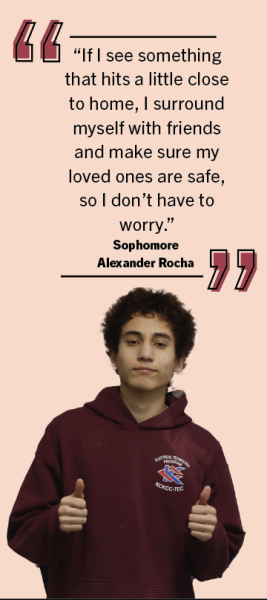
Ignoring all negative content can be difficult; instead, some students, like Rocha, use their relationships with their friends and family in order to help deal with the stress and anxiety that comes with staying informed.
“If I see something that hits a little close to home, it might affect my mood for maybe a week or a couple of days,” Rocha said. “[So I] surround myself with some friends and make sure my loved ones are safe, so I don’t have to worry.”