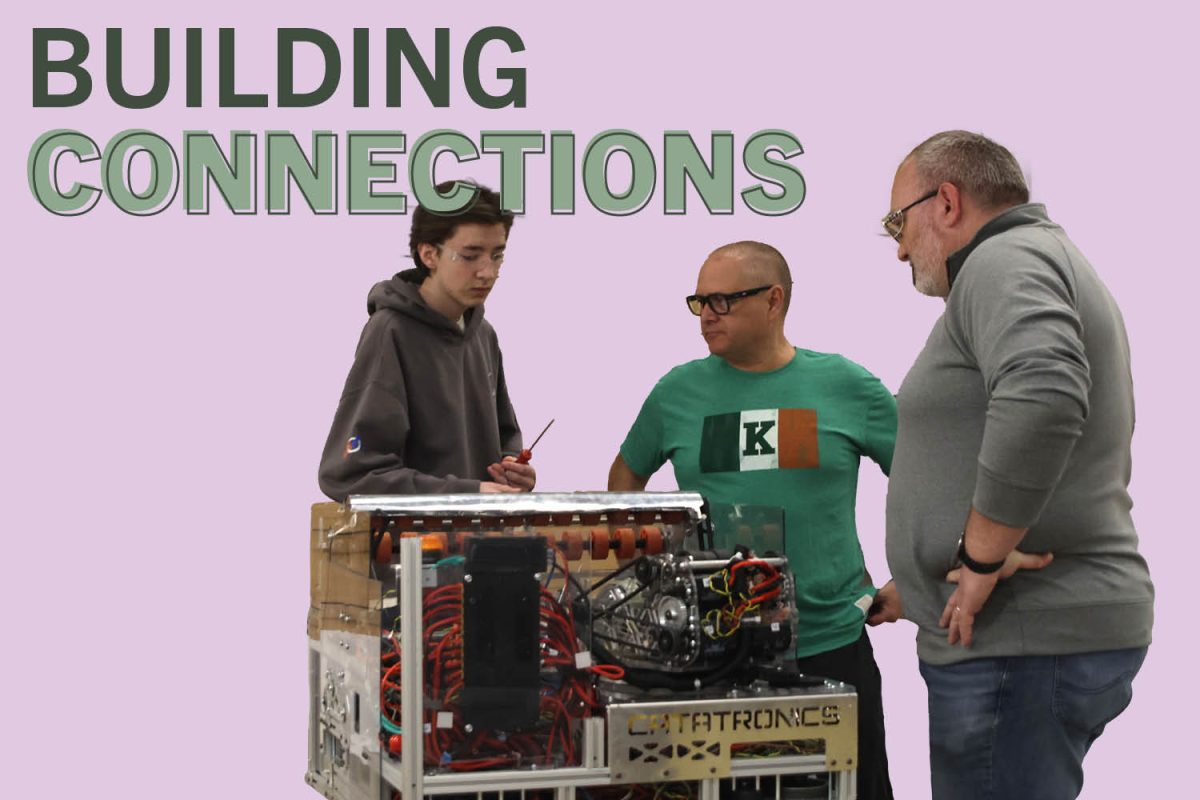
Adult mentors, many of whom are community members that volunteer their time, function as a crucial aspect within the school’s robotics program. They act as scaffolding to help educate and support students as they create a competition-ready robot.
Robotics mentors help students design, build, drive and repair robots throughout the season. According to mentor Tony Lauer, one of their main objectives is to steer students throughout the season.
“They definitely need some guardrails to keep them on track,” Lauer said. “We are on a timeline in terms of when our competitions are, so they need to learn the value of having a deadline, sticking to it and maintaining focus on the job.”
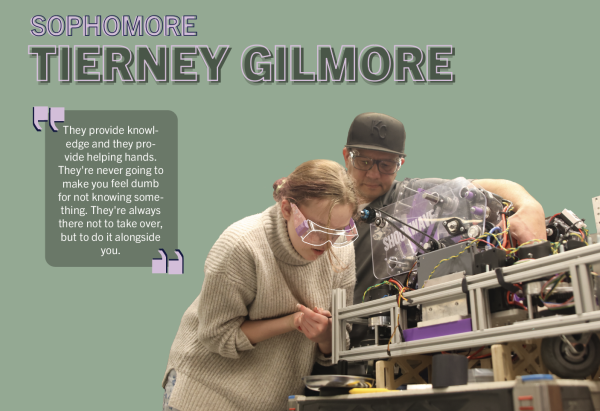
Beyond just keeping students on track, many mentors provide valuable insight from years of experience. Sophomore Tierney Gilmore appreciates how the mentors are always willing to help.
“They’re never going to make you feel dumb for not knowing something,” Gilmore said. “They’re always there not to take over, but to do it alongside you.”
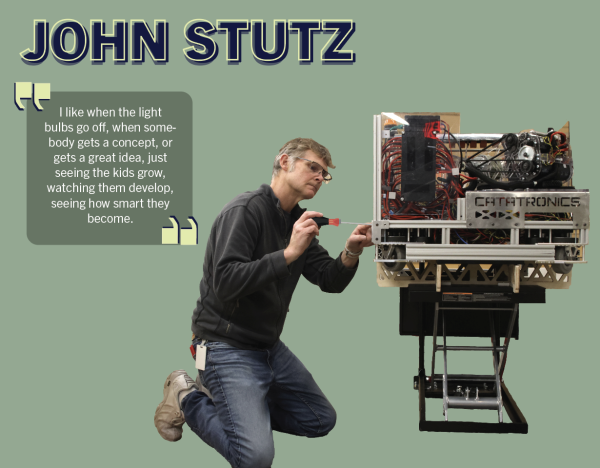
 Mentors range from parents of current and past students to community members who work in related fields. Mentor John Stutz works as an industrial engineer at Garmin and has enjoyed getting to lead students and see them develop their own leadership skills.
“[In robotics,] there’s lots of working in team environments [and] learning how to work with others,” Stutz said. “I [tell] a lot of the kids that if I assign you a task, it’s not necessarily that you do the task, but you’re responsible for the task.””
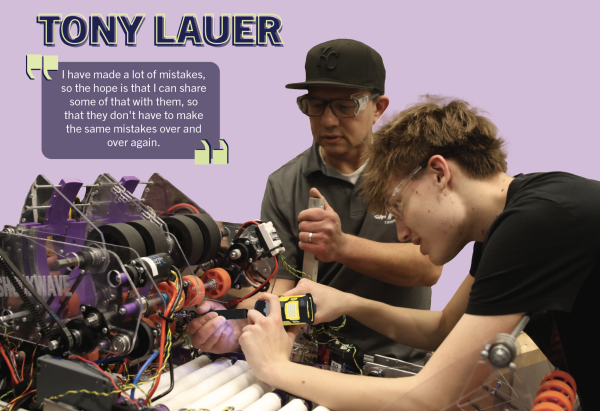
The leadership mentors provide is crucial for students as they are often starting with minimal knowledge of robotics. That piece of mentoring has always been especially important for Lauer.
“I have made a lot of mistakes in terms of working with remote control items or I have burned up a lot of motors,” Lauer said. “I’ve made all those mistakes before, so the hope is that I can share some of that with them, so that they don’t have to make the same mistakes over and over again.”
 While mentors are there to help students throughout the entire robotics season, it is the students ultimately building the robots. Mentor Mike Pentecost has been with the program for 20 years and has witnessed just how unique that aspect is.
“It’s their robot; it’s not our robot,” Pentecost said. “We’re there to guide them, steer them. You’ll see some teams where the mentors, it’s their robot. The easiest way to tell the difference is to watch when the robot breaks and see who’s working on it. With us, the kids are working on it.”
Echoing Pentecost’s sentiment, sophomore Oakley Hughes explains that the mentors are there to guide students and empower them to solve problems.
“What’s great about mentors is they’re so eager to teach you how to do it, but also let you be creative with your own ideas,” Hughes said. “If you bring them with a problem, they want to know what you think the best way to solve it is, because they want us to figure out how to work through these things.”
Mentors commit a lot of their time to the team from almost daily practices to weekend competitions. For Pentecost its building relationships with students that makes volunteering with the program so fulfilling.
“I think it helps keep me young,” Pentecost said. “I keep telling the kids that I get as much out of it as they do, they don’t believe me, but it’s true. I can have a terrible day at work, and I come to robotics, and it just washes it away.”
For Lauer it’s more about seeing how much students can develop in just a semester or in four years.
“You see the growth of the student: [they go] from somebody that you have to explain everything to, to somebody that’s being fairly self-sufficient and can do things on their own, or can build the whole robot on their own,” Lauer said. “That is a student robot, mentors are not heavy handed in the junior and senior robot, that feels good.”
 While mentors gain a lot from working with students, according to Gilmore it is ultimately their guidance that keeps the program running and helps team members to develop their skills.
“The mentors are probably the biggest thing holding robotics together,” Gilmore said. “When I became a team lead, I was really worried that I wasn’t going to know everything because I’m a sophomore, so I’d only had one year on the team. Having those mentors boosted my confidence coming into that leadership role, because I knew that if I ever needed anything, I could ask them.”