

CULTIVATING COOKS
Through the off-campus culinary class at Eudora-De Soto Technical Education Center (EDTEC), senior Jake Brown and juniors Alice Hoelting and Sebastian Coats get early, hands on experience in the kitchen before going to culinary school.
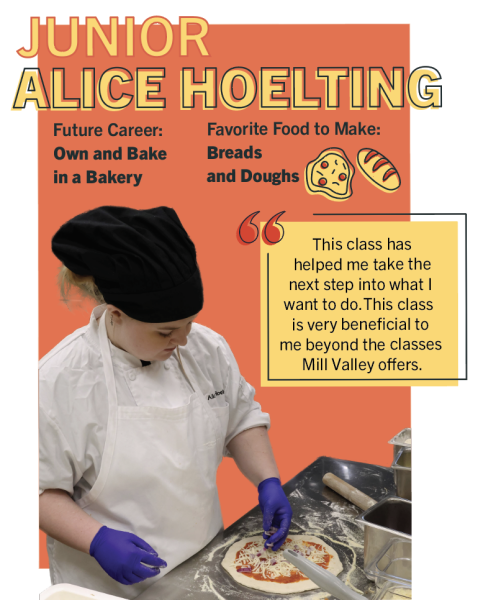
Hoelting chose to take the class because she hopes to own a bakery.
“I thought [taking this class] would be a good next step for me, and I’ve always wanted to do something with food,” Hoelting said. “I always loved food, so I thought it’d be a good opportunity for me and something that could help me get out of my shell and get away from the school for a little while.”
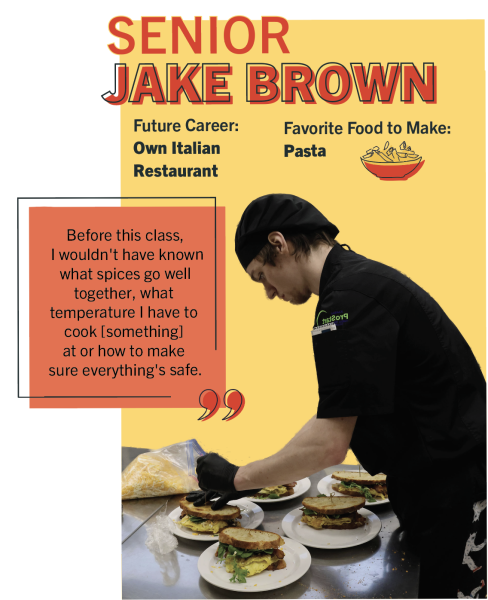
As for Brown, he plans to own and operate a high end Italian restaurant after college.
“I decided to take [the class] to further my education in culinary,” Brown said. “I wanted to understand not only how to cook, but what goes on behind the scenes in a restaurant.”
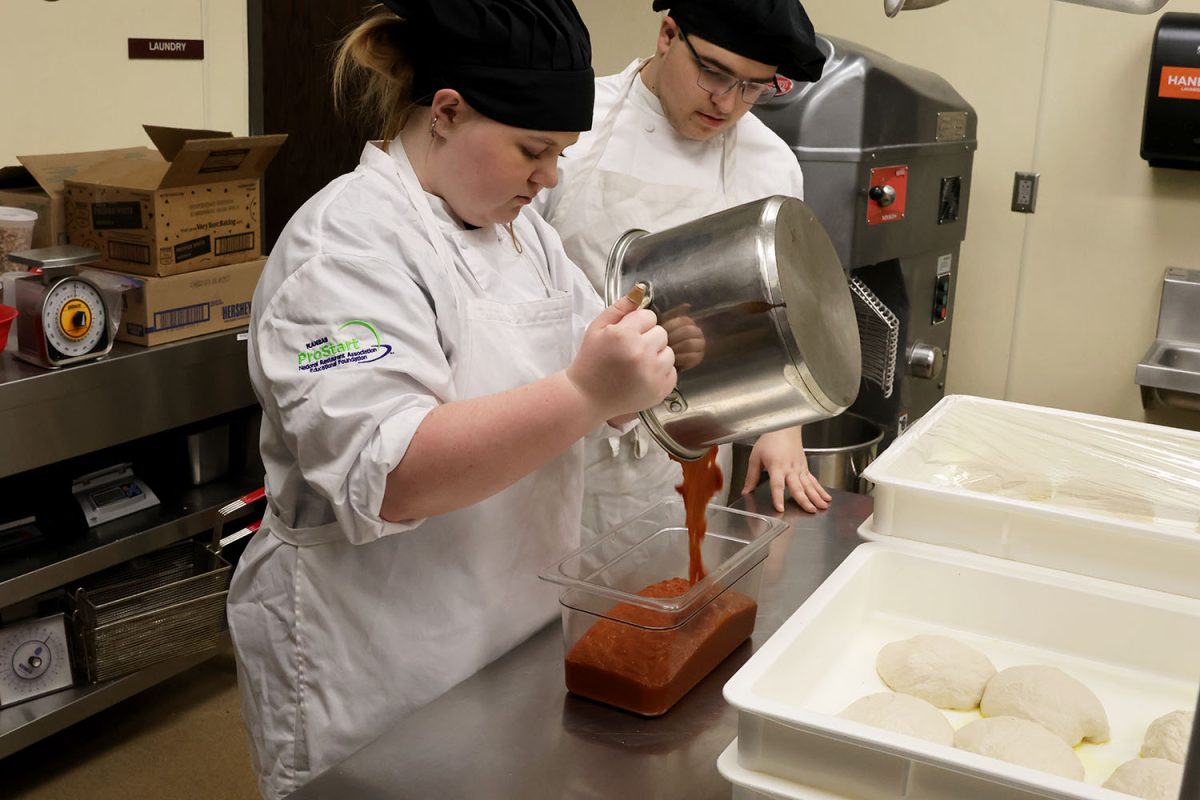
The class starts at 7:18 a.m. in the EDTEC industrial kitchen, where students are expected to arrive quickly and get dressed in their chef coats and hats. The class ends at 8:54 a.m., giving the students limited time to complete what they are making for the day.
The class starts with lectures at the beginning of the year. They focus on safety, equipment use and expectations within a professional kitchen. However, students are mainly expected to learn skills by practicing them as they complete recipes.
Hoelting appreciates the class structure because it’s set up similarly to how a restaurant or bakery would function, rather than a normal class at the school.
“I definitely think it’s helping be
cause it’s the next step up from what we do at school,” Hoelting said. “[The class is] very much like if you had a boss and you had to figure out how to complete things. It’s not very difficult, but I [like] having to do stuff on my own and not having a teacher to guide me through the whole thing.”
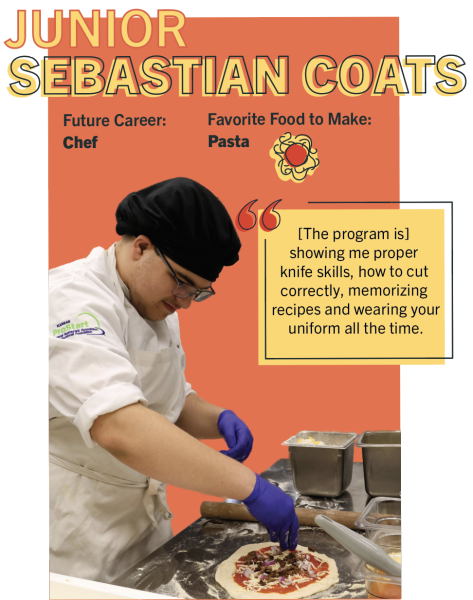
Coats also enjoys the class’s structure because it is helping him prepare for his future as a chef.
“[I thought this class] would give me a better chance of getting into a high-grade culinary school,” Coats said. “[The class is] showing me proper knife skills, how to cut correctly, memorizing recipes and wearing my uniform all the time.”
The EDTEC class allows students to be independent, but also able to ask for help from the teacher if they need it. Brown feels the class will give him an advantage when he goes into culinary school in the future.
“I think that the class makes me understand culinary more, and it makes me feel like I have a one-up on everybody because I took this class,” Brown said. “It’s just so much knowledge that you wouldn’t get [at the school] or at De Soto.”
OUTSIDE THE BOX LEARNING
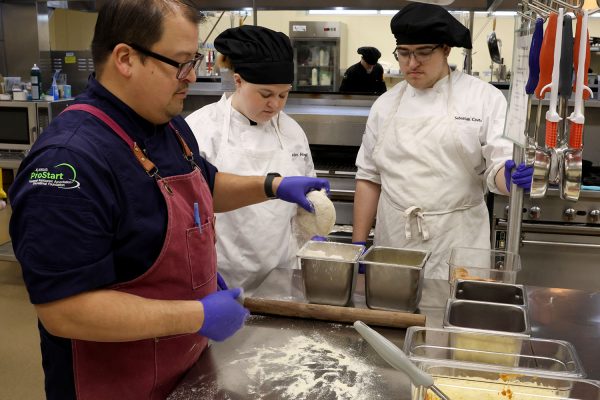
The EDTEC class structure, appliances, materials and experienced teachers help its culinary students expand their skills past what the school’s standard culinary courses can offer.
Hoelting likes the kitchen at EDTEC because it models one she would find in the real world.
“It is very much an industrial kitchen that you see in the restaurant,” Hoelting said. “It’s very helpful to know and learn how to use those appliances before you go into that field.”
Culinary teacher Jack Low has worked in the restaurant industry and has experience as a chef. Brown appreciates how he can provide more insight into how a restaurant functions and how to manage one.
“My teacher has been working in restaurants for 30 years before becoming a teacher,” Brown said. “He knows the ins and outs of restaurants and businesses.”
Low graduated from culinary school and has worked in different types of professional kitchens. He believes his class teaches students skills that can be used in the future.
“Not only is the base knowledge important, but the emphasis on work ethic, sense of urgency and teamwork no matter who it’s with [is also important],” Low said via email. “Learning to work with people you don’t like or agree with is a hard lesson to learn, and the fast-paced, low-error environment that is the kitchen is very hard to lecture and simulate, so giving them real world experience [through cooking] gives them an advantage.”
The class size at EDTEC also differs from that at the school. The culinary class at EDTEC has six students, while culinary classes at the school have around 15 to 20 students. Hoelting prefers this aspect.
“I think this class is very beneficial to me beyond the classes Mill Valley offers,” Hoelting said. “It’s a lot of the same curriculum, but it’s a higher curriculum than what we can do at school because of the amount of people, [which means] we can do more [at EDTEC] than we can here.”
The downside of taking an off campus course is the distance students have to travel daily to make it there. Although a bus is offered to the students who do not want to drive, students still have to wake up early for class and arrive back at school late for their second block.
Even so, Coats believes traveling the distance is justifiable for what the course provides.
“I like not having class in the morning,” Coats said. “I think the distance is worth it because [chef] went to culinary school, so he will teach you more about what to do in the kitchen, where everything goes and proper technique.”
Despite the drawbacks, students, such as Hoelting, like taking the course in high school because it is cheaper, gives them early experience in the culinary field and gets them out of the school.
“I think [going to EDTEC] helps get people out of their comfort zone and out of the school,” Hoelting said. “It really helps boost your independence. At school, you can get very comfortable in what you’re doing, and there aren’t many [different ways of] thinking and learning.”
CUTTING EDGE COMPETITION
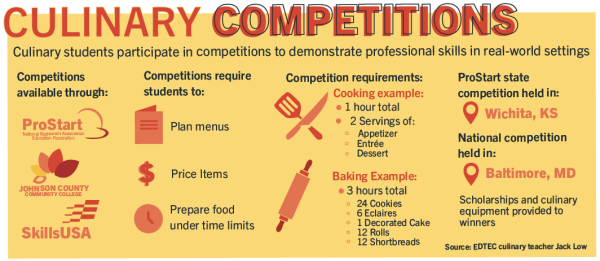
Another important aspect of the culinary class at EDTEC is that it provides different competitions through Johnson County Community Culinary School, ProStart and Skills USA that students can compete in, giving them the opportunity to get scouted by culinary schools.
(By Jason Sweany)
According to Low, these competitions allow students to practice skills that they can use in a professional kitchen.
“The competitions help them prepare for all of their future,” Low said. “Time management, teamwork and creative development are all being formed and introduced to them in these competitions, which give them real-world experience and advice that they can use in most professional fields.”
These competitions are split into individual and team events, allowing competitors to choose between culinary or hospitality events. Culinary events focus on cooking or preparing something for judges, and hospitality events center around things like restaurant development and table service.
Brown is a part of the management team, competing at ProStart, which means he must fully come up with and design a mock restaurant to present to a board of restaurant owners and investors in April.
“Being on the management team is showing me how to run a restaurant and how to build it from the ground up,” Brown said. “Since that’s what I want to do [in the future], it’s super helpful because I’m able to gain that knowledge and be able to pursue my dreams further.”
Students who win the competitions have the opportunity to win awards and scholarships to culinary schools. These scholarships can range from local, like Johnson County Community College or Kansas State University, to national, like the Culinary Institute of America or Le Cordon Bleu.
Opportunities like these competitions are just one of the ways that EDTEC gives students, including Brown, a leg up going into their culinary careers.
“[EDTEC offers] all the trades like other trade schools,” Brown said. “It brings out a different creativity from the students, and it expands everybody’s minds to be like, ‘Oh, I could do this as a career,’ and it helps lead them on that path.”