
During this academically intense period before semester finals, students are increasingly using AI to study and prepare for exams.
The use of generative artificial intelligence is becoming more common in school: according to Pew Research Center, about a quarter of US teens have used ChatGPT for schoolwork as of January 2025.
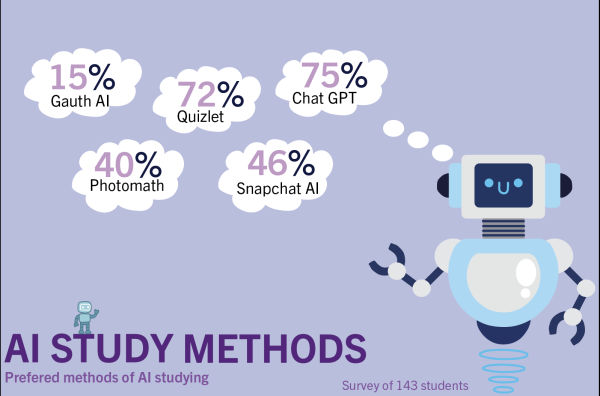
Other various generative artificial intelligence platforms exist, but ChatGPT is the most popular for its role in education. Sophomore Jon Riley uses the app to prepare for tests such as final exams.
“I mostly use ChatGPT to study,” Riley said. “I take the review guides that our teachers give us, and then it explains how you get to the answers. AI is really helpful.”
Senior Landon Vincent also uses AI to better understand topics, especially when he is unable to find someone to help, but he uses from multiple different applications.
“[I use] Chat GPT, [and] sometimes SnapAI or Copilot.” “When I don’t have a teacher or an answer key, I can use AI so I know I’m [studying] right,” Vincent said.
However, there must be caution to avoid engaging in academic misconduct while obtaining assistance from these tools, Riley points out.
“They [might say] that you’re cheating by using AI,” Riley said. “You just have to use it responsibly. You don’t use it for getting answers on homework. [AI] is just for studying on your own time.”
Depending on the subject, some teachers approve of generative AI usage in their classrooms when used in a certain way. English teacher Michael Strack supports a moderate use of AI when it is on a smaller, more technical scale.
“In my subject area, if you take a small portion of what you write and you want some more concise wording and plug it into AI to get some feedback, that’s appropriate,” Strack said. “[However,] I would urge students to resist putting their entire writing into AI to get feedback.”
Regardless of how AI is used, its effect on education is still developing. Strack stresses the importance of true learning without these engines due to how uncertain the future of AI is.
“[AI is] ever changing, and it’s really challenging,” Strack said. “Ultimately, I want kids generating their own thoughts as much as possible, but AI is not going away, and obviously it’s going to be a part of education moving forward. We have to figure out how we can teach kids to use it in a way that benefits them and doesn’t just replace their thinking.”