
As a young student, it’s hard to maintain attention with the many distractions of everyday life. There have been many nights that I have tried to focus on my homework without any aids to no avail. However, this is not due to an energy issue, and consuming caffeine-based stimulants such as energy drinks is fruitless. I’ve learned that the best way for me to sustain my focus while doing schoolwork is to adjust my environment with neuroscience-based strategies, something I think everyone would benefit from trying.
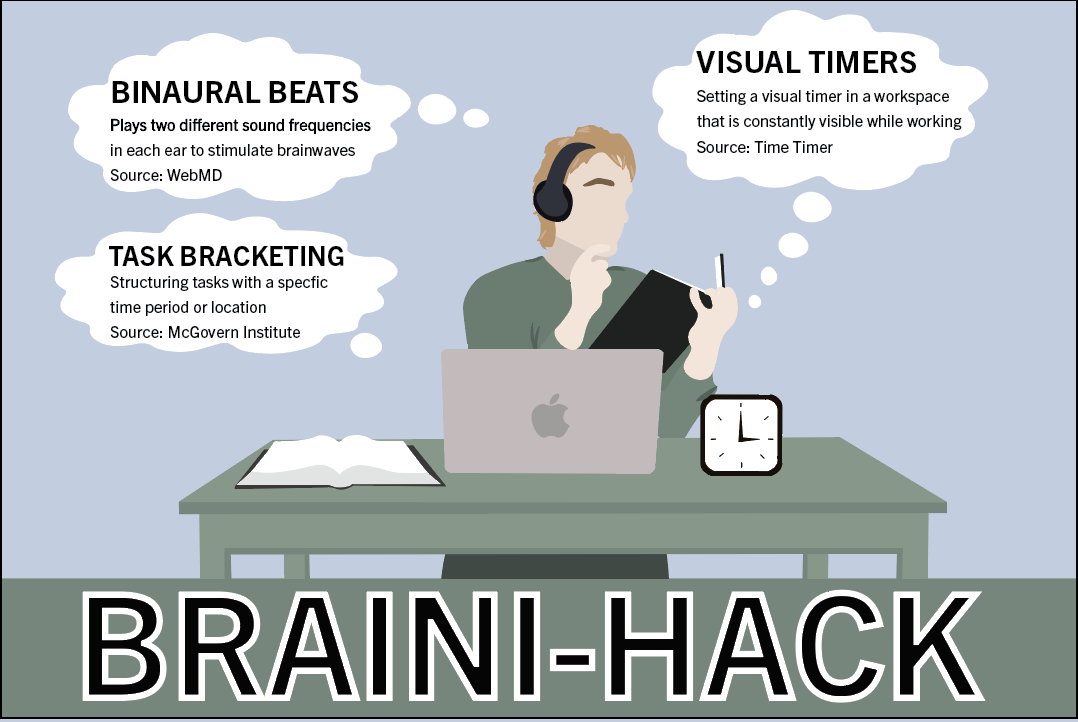
When the world gets too noisy for productivity, one way to tune it out is to put on headphones, switch off the stimulating playlist and turn on some binaural beats. Binaural beats are auditory illusions that occur when two slightly different sounds are played in separate ears at the same time. They are accessible as recordings through music streaming services. According to Psychology Today, 13 Hz to 30 Hz binaural beats are the best to listen to when trying to focus because they align with beta brain waves associated with concentration.
After setting the mood for a high-attention session, I find it helps to set a specific task to work on.
According to the American Psychological Association, doing more than one task at a time reduces efficiency. Common sense and my past experience dictate that it is easier to direct energy towards one step at a time.
But deep concentration cannot last forever, no matter how resilient you are. That’s why it is important to create time limits. The urgency to finish work before the clock runs out is incredibly motivating, while the end provides the closure needed to take a break, something that will actually improve productivity in the long run.
Although some may argue that an easier method to cope with a lack of focus is to ingest energy drinks, the neurological hacks I described work better for me because they are more sustainable and avoid side effects. The Food and Drug Administration recommends that teens avoid energy drinks due to the high caffeine levels, which can lead to distracting symptoms such as increased heart rate and anxiety. Using environmental tricks that don’t involve consumable substances is more reliable for me.
No one, especially teens, has complete control over the disorienting aspects of the world. A practical idea for students is to experiment with harmless strategies rooted in neuroscience to increase attentiveness. If the brain is like a computer, it is then possible to hack it.