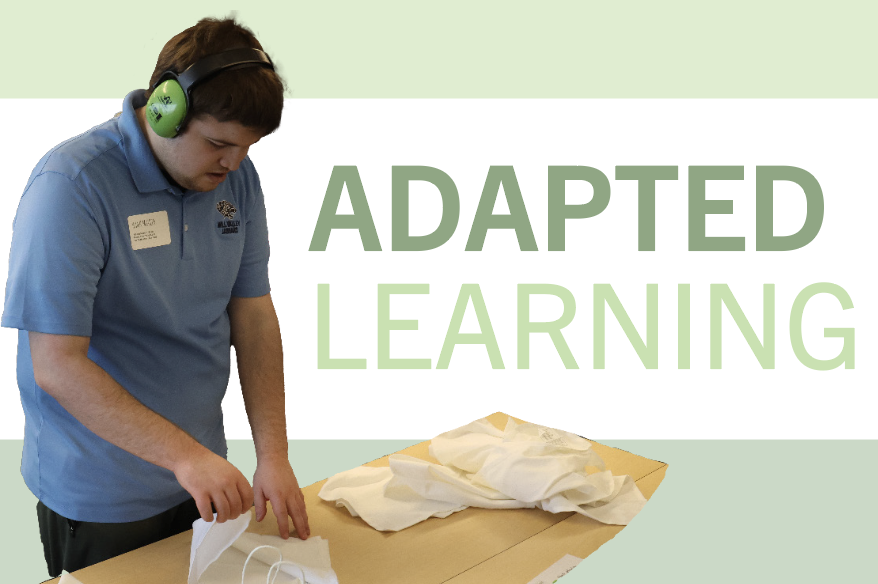
Peers in Learning is a unique program that gives students with special needs a chance to interact with their peers in ways that help them learn and focus better.
The program pairs students with special needs with a peer who accompanies them to a class. During their assigned class, peers complete many different activities that range from academics to daily living skills and community outings, helping them with focusing on these tasks as they learn new things and help them with their social skills.
The program is led by special education teacher Sara Evans, who came here after the program first became available, but knows the intent of the course was to make students with special needs feel more connected to their peers at the school.
“The intention of it is to have typical peers working with our students all day,” Sara said. “Most of our students are in the center based program due to their needs and going out to classrooms is not the least restrictive environment for them. In order to have inclusion and interactions with peers, we bring the peers to their environment, which is more conducive to their learning.”
Sara has also seen first hand just how much the peers have helped the students with special needs, in ways ranging from academics to their people skills.
“[The students] benefit greatly because otherwise, it would just be the students and adults all day long,” Sara said. “They learn a lot from their peers’ social skills. Sometimes, it’s just better to be told what to do or what not to do by someone your age rather than an adult.”
This program also gets students with special needs important experiences that they will need later in life, as junior Abby Stidham-Ebberts has seen first hand in her time as a peer.
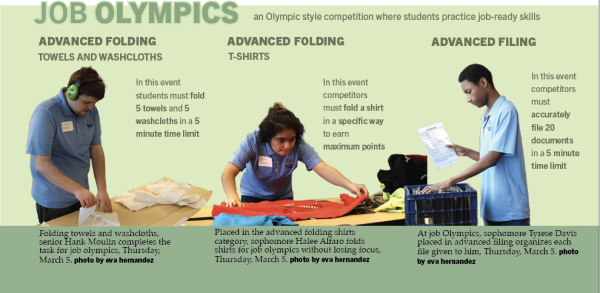
“They do a lot of real world, hands-on life skills that are very useful for everyone and it’s also really useful how they do Job Olympics,” Stidham-Ebberts said. “Every activity that they do in class is going to help them with the Job Olympics and help them show off their work that they’ve been doing in class, so I think that’s really cool.”
Although the main objective of the program is to help the students with special needs, Sara also believes this program has helped the peers learn things that they wouldn’t learn in any of their classes.
“[The peers] learn a lot about empathy, and they learn a lot about inclusion,” Sara said. “One thing that I’ve noticed is the school is very inclusive, and a lot of that is because of the peers. When they get to know our students, they introduce our students to their friends, and then everybody knows everybody.”
Senior Jason Evans, who has taken this course for four years, believes the connections he has built with the students are the best part of the program.
“I want to say the field trips [are the best part], but there’s a lot of different kids, and every single one of them is awesome,” Jason said.
Sara also believes that the connection each peer makes with students with special needs helps fight against any stigma surrounding these students.
“This class helps combat a lot of the stigma towards children with disabilities,” Sara said.
“If you see a student in the hall, and you’re not really getting to know them, you automatically assume one thing or another about them, but then actually getting in the classroom you get to see a lot of the amazing things that they can do.”
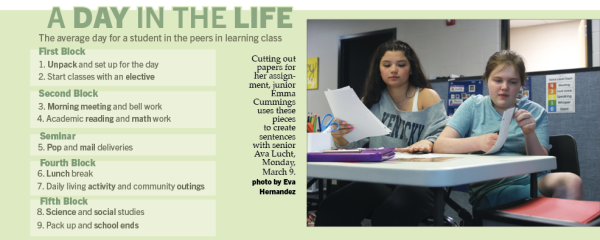
In his class, Jason gets the students with special needs ready for the rest of their day by watching a variety of educational videos to help them learn different things.
“We do morning meetings and we’ll say the date and days of the week,” Jason said. “[We] watch a lot of videos to help learn the days of the week and help learn different weather and different feelings.”
In her class, Stidham-Ebberts completes tasks with her assigned students that include filling up coolers with snacks and water for the physical education teachers and collecting recycling from the classrooms around the school.
Stidham-Ebberts feels that the program opens up opportunities for students to accomplish more with their peer interactions.
“Learning disabilities can make [doing some tasks] hard, but when they have people around them motivating them or encouraging and supporting them through their activity, it makes it more fun and easier to complete,” Stidham-Ebberts said.
In her first year in the program, sophomore Haylee Myers enjoys helping the students in their Unified Physical Education class, where they play modified versions of popular sports, sometimes even replicating the Super Bowl and Olympic games.
“I really enjoy making them feel welcome in the school,” Myers said.
Stidham-Ebberts believes that the program has helped her improve her own skills in many different ways, ranging from self improvement to academics.
“I learned how to have better positive talk to others and to myself, and I’ve learned how to use encouragement to help people,” Stidham-Ebberts said. “[The program] is so fun, and it’s a great way to work on your own skills while also helping others.”