
Collecting items allows people to spend time doing a hobby they enjoy while curating an assortment of pieces they are proud of. These things can be anything from normal trading or sports cards to vintage clothing items.
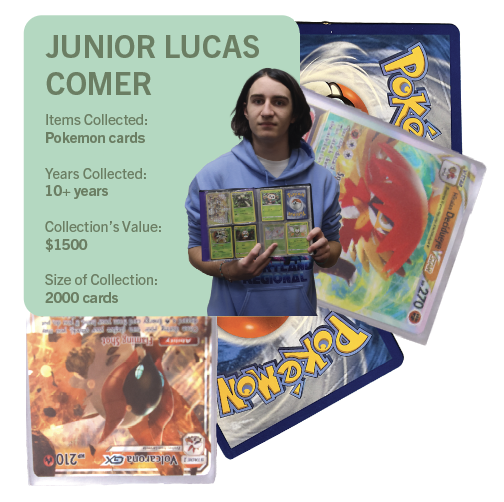
One of the most common things people like to collect is sports cards or other various trading cards. Junior Lucas Comer has collected Pokémon cards since he was five, and he has continued to do so because
collecting them has helped him build a community where he can play with others.
“[Collecting things is] a great way to get into a new community, meet new people and do something fun,” Comer said. “I’ve played [Pokémon] regularly on Fridays at a local store, and I’ve met a lot of people there. I have a few friends that I go [to the store with], and I’m starting to know the people that work there.”
Comer enjoys playing at the store because he can meet and bond with others over a shared interest.
“I feel a sense of community because we all collect the same thing, and we all have different favorite [cards],” Comer said. “At the end of the day, we all just collect Pokémon for the [heck] of it.”
Unlike collecting more common items like trading cards, sophomore Nik Ayers collects various animal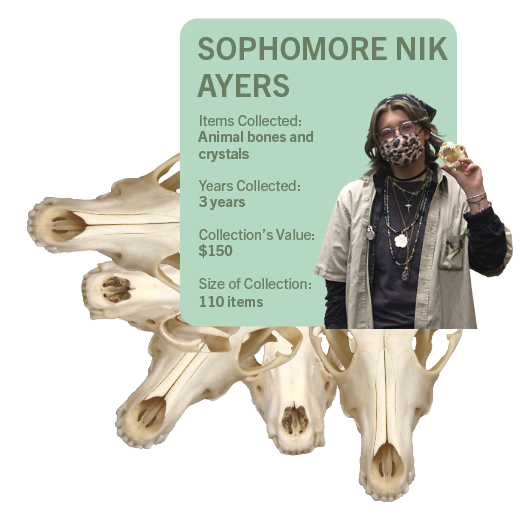 bones and crystals.
“I first started collecting bones when I was in seventh grade,” Ayers said. “I was at a Renaissance fair, and I saw a seller who had a bunch of different taxidermy and animal skulls. I talked to them about the idea of honoring an animal in their past lifetime. For me, it’s a way of paying [my] respects towards the life that those animals had.”
Ayers collects animal bones because he feels it is important to memorialize an animal’s past life.
“In my opinion, choosing to honor the animal by appreciating them even past their life is worth more than seeing it raw, alone in a pile,” Ayers said.
Although collecting animal bones may be more unusual than collecting items like shoes or vinyls, Ayers still believes it’s important for people to collect the things that one likes.
“Even if you don’t understand what someone is interested in, it’s always fun to have a hobby, and it’s interesting to learn about other people’s hobbies,” Ayers said.
Ayers has a process of cleaning and disinfecting the bones he finds to collect them safely. Through a cycle of washing, cleaning and soaking in hydrogen peroxide, Ayers makes sure what he collects is free of germs and looks appealing to take care of them.
Freshman Lillian Sickel also takes care of and collects her language books, like dictionaries and thesauruses, that she finds at book sales. Sickel started collecting because of her great grandpa.

“My great grandpa was a lover of words, so I think I probably got [my love for collecting] from him,” Sickel said. “He was never alive when I was alive, but I would always get told stories about what he would do, and it’s a lot like what I do now.”
Sickel enjoys collecting these different language books because she is interested in them, and they help her learn more about words she might be unfamiliar with.
“It makes me feel very satisfied,” Sickel said. “It’s really fun to compare them from different years, because there will be different words from different years that they classify.”
This is similar to sophomore Jacob Lowry, who started collecting loose-leaf teas and bone china because he had an interest in the subject.
“I traveled abroad to Canada, and we went to an afternoon tea there,” Lowry said. “That got me very interested in [collecting tea]. It was very interesting to talk with [the wait staff], because they have a lot of insight on the different types of teas, where they come from [and] what they’re made of.”
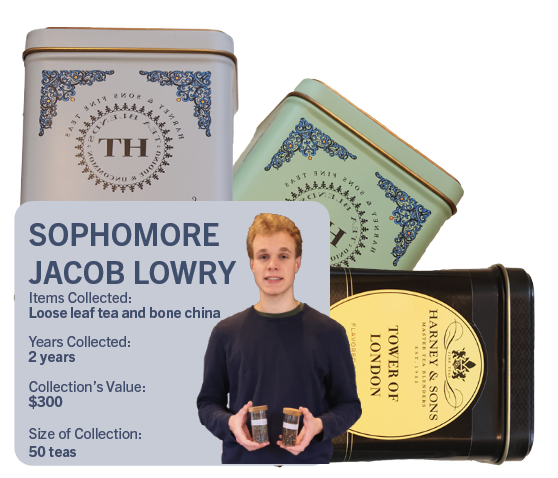
To share his collections with others, Lowry frequently hosts afternoon teas for himself and his friends. Not only does collecting teas help him bond with others, Lowry also enjoys collecting because he is fascinated in the topic.
“I would say it’s something for me to spend my time on,” Lowry said. “I find it interesting. I like learning about it, I like reading about it. I think it’s a good use of my time.”
Many students collect items for different reasons, but Ayers believes people collect things out of instinctive human nature.
“I think collecting things helps us cope and gives us an outlet for our human tendency to hoard certain items,” Ayers said. “A collection of one thing can prevent hoards of trash. Instead of people keeping cups and paper bags, they are more likely to think about what they’re collecting because of the cost or about the significance of the items.”