School faces security’s new reality
February 7, 2013 by asantaularia
Filed under NEWS, School, Top stories
With the recent tragedy at Sandy Hook Elementary still generating a lot of debate, school districts across the country have been forced to shift their attention to the issue of school safety, and De Soto is no exception. While the district and school are taking steps to address security concerns, many students and teachers feel like more work needs to be done.
According to director of administrative services and community relations Alvie Cater, the district is taking many steps to increase the safety of the schools, including a focus on improving intruder drills.
“We are increasing the frequency of intruder drills because training is important,” Cater said. “But each incident is different and you have to be prepared for a variety of things. What we’re trying to do is come up with the best practice. Then we have to know that our staff knows what to do and our students know what to do. It’s an ongoing process.”
Chairman of the Building Leadership Team Brian Rodkey also believes that practicing intruder drills more routinely would make students and teachers more confident with the procedure. The first intruder drill of this year occurred on Thursday, Feb. 7. While the school does practice an intruder drill once every year, last year’s drill practiced only the lockdown portion of the procedure. Students and teachers were only told to lock their doors as the drug dogs entered the building and were not required to practice hiding or other procedures for dealing with an intruder in the building.
Rodkey said intruder drills need to be increased and improved.
“We practice fire drills time and time again,” Rodkey said. “As soon as the fire alarm goes off you assume it’s a drill, not a fire. Then students don’t panic. It’s the same with an intruder drill. If there’s an intruder and you know what you are supposed to do, your level of anxiety goes down.”
Freshman Shelby Badger is one of the 339 students in her grade who have never gone through an intruder drill at the school, something she sees as a large potential problem.
“I have no idea what the school wants me to do if there’s an intruder,” Badger said. “[A large group] of students don’t know what to do. It’s a little bit unsettling.”
Junior Jordan Fisher agrees with Badger.
“We used to practice [intruder drills] all the time in elementary school, but now we don’t really practice them at all,” Fisher said. “I think [the administration] should tell us more of what to do.”
Rodkey also believes that intruder drills should be updated and encompass more situations to better prepare students, such as explaining what to do if a student were in the hallway, bathroom, lunchroom or library.
“I think the current plan is great in the first steps,” Rodkey said. “[But] the last thing I want to be doing is lying on the floor when someone comes in to kill me. I think that last part of the plan is outdated … We should [also] be able to come up with a reasonable plan of what to do in an ‘everyday life’ scenario … You would like to go your whole career never having an intruder in the building. But it’s hard to later think that it could have been stopped if we had prepared and communicated better.”
Whether there’s a plan in place or not, it hasn’t been communicated to a level where every person in the building knows how to respond.”
After hearing these concerns, Principal Tobie Waldeck ensured that certain changes will be made to the intruder drill procedure.
“What is going to be done to take certain [concerns] into account is we will increase the frequency of intruder drills and the first one next year is going to be done in August,” Waldeck said. “Also, I think having an intruder drill during lunch is a good idea … We realize the importance of this. The district is committed to school safety, as are we.”
Also part of the process for analyzing security, members of the Building Crisis Team have met to examine the safety procedures. The school’s team has met twice since Sandy Hook, and consists of teachers and administrators, including school psychologist Debbie Gudenkauf.
“There’s no way you can ever be prepared for every single scenario,” Gudenkauf said. “You have to make sure the bones of the plan are solid but fluid enough to adjust to different situations.”
Waldeck has been involved in both meetings and believes the school is working toward its goals.
“Our goals are to provide as much normalcy in the building as possible and to keep kids safe,” Waldeck said. “Returning to normalcy promotes calmness and consistency, and it prevents panic. We don’t want a knee-jerk reaction. We want to think through methodically how we are going to handle various situations.”
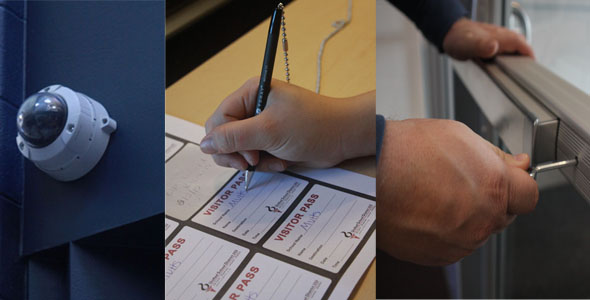
If an intruder were to enter the school, they would first have to go through the office. In order to prepare if this situation ever occurred, Homeland Security made sure the receptionists knew their duties.
“[Having an intruder] come through the office is a lot better than them just going into the school,” receptionist Lynn Bath said. “We each have specific jobs that we are supposed to do in case of an emergency. Homeland Security came in and they were very intense. They just drilled us. It was almost as if they wanted us to be anxious, as we would be in an emergency.”
School nurse Heather Van Dyke, a member of the team, believes that the team has been accomplishing its objectives.
“I think it’s been great,” Van Dyke said. “Mr. Waldeck has been right on it. They had all of the information there and meetings have been largely to review … It just comes to the forefront unfortunately [after an incident like Sandy Hook].”
While many teachers and students are pleased that the team members are meeting to discuss further safety options, some have concerns they believe should be addressed, including classroom doors that can only be locked from the hallway as opposed to from the inside of the classroom. Math teacher Kristen Chavez is one of many teachers who have these locks.
“If we were to have an intruder, I’d have to open the door to lock it,” Chavez said. “I [feel] that doing so would put the students at risk.”
Waldeck believes that the team will look into the locks.
“I think they are working with police, the fire department, etc. to see exactly what can be done,” Waldeck said. “That is not an inconvenience that is strictly in this building, and it is a concern that has been communicated.”
Until the problem can be fixed, Chavez has decided to keep her door locked at all times.
“[Because I lock my door, it is] kind of a pain to get up every time, but it really isn’t that big of a deal,” Chavez said. “I feel like I can do my part to keep my students and myself safe by becoming more aware of strangers.”
There are also issues some teachers and students have regarding the crisis manuals that are supposed to be available to teachers in every room. The manuals were removed during first semester to be updated, but they have not yet been returned. The manuals were being updated with easy-to-understand language, but they are currently not finished.
“For me as a seasoned teacher, I pretty much know protocol for crisis situations,” English teacher Dorothy Swafford said. “But as a new teacher I can see how that can be stressful to not understand protocol or know what steps to take.”
While Cater sees the need for manuals to be distributed back to teachers, he believes they should be used before a crisis, not in the event of one.
“The [crisis manual] is designed to help prepare staff in advance,” Cater said. “In the event of a crisis, clear communication is going to be the best thing … [The changes are] definitely in response to what happened in Newtown. The tragedy in Newtown is a shift in the paradigm. It’s going to be part of the national conversation and this is just an extension of that.”
Senior Alyx Stephenson is also concerned about the lack of communication between teachers and administration.
“In general I feel pretty safe at our school,” Stephenson said. “But I think we could do better at educating everyone on the plan of action in case of an emergency. Teachers are supposed to be the ones protecting the kids and if the teachers don’t know what to do, they’re putting students’ lives at risk.”
Librarian Andy Shelly has had to deal with a school crisis before first-hand. The middle school Shelly taught at as a math teacher in the early 1990s in Kansas City, Kan. experienced a school shooting. A student walked into the lunchroom and fired shots, injuring two students.
“If you think about the number of schools in the country and how many incidents have happened at those schools in the last 50 years, I don’t think anybody imagines that could happen at their school,” Shelly said. “But you have to try to prepare yourself for the worst possible scenario. I didn’t think it could happen where I was at and I don’t think it could happen here. But you have to prepare for the worst.”
Waldeck realizes that the current problems with communication need to be solved and is willing to work toward finding solutions.
“As a principal, the last thing I want is for the staff and students to be confused or not feel safe,” Waldeck said. “Absolutely there are things we could improve. [Sandy Hook] has opened a lot of eyes. We do take it seriously and we are willing to make corrections … We will conduct drills, get SRO input, gather information from the Building Leadership Team, make adjustments and repeat. I love my staff and I love my students and I want to take care of them.”
NHS members model in Natalie M. fashion show
Members of NHS modeled prom wear in the Natalie M. fashion show at the Overland Park Convention Center on Sunday, Jan. 13. Other schools from around the Kansas City area participated in this fashion show to help raise money for their schools. Each student had to sell 20 tickets at the price of $5.
Senior Brenna Iskra said she enjoyed modeling and choosing her dress.
“We got to pick out our own dress and it was basically like going to another dance,” Iskra said. “You got to model and walk with your friends and it was just a really good experience.”
The group raised $2,900 for the NHS program. NHS sponsor Kristen Chavez said she plans to use the money for self-defense classes for students.
“Part of the money we raised, we are going to [use it on] the TAKE Foundation,” Chavez said. “We are going to try to offer a TAKE class for free to the students of Mill Valley and the community.”
The TAKE Foundation (The Ali Kemp Education Foundation) is a group that specializes in self-defense classes. Originally, the Natalie M. fashion show was called Ali’s Runway and was sponsored by TAKE, but is now sponsored by Natalie M. Foundation.
Chavez was disappointed in the ending of Ali’s Runway, but hopes to provide defense classes for all girls with TAKE.
“It made me very sad when we stopped doing Ali’s Runway,” Chavez said. “I am a very firm believer that every girl should have some type of self-defense training.”
Students qualify for quarter one REACH party
Around 506 students filed into the commons, giving their tickets to staff members for the REACH party on Tuesday, Nov. 6.
NHS hosts this event after every quarter for students who make the Principal’s All A Honor Roll and the A/B Honor Roll. During the REACH party students can participate in a cakewalk, earn food prizes, play card games, frost sugar cookies and hang out with friends.
Senior Marinela Koleva says that the REACH party lets her take a break from seminar.
“I like the free food,” Koleva said. “Also, [I] can get out of seminar and just relax.”
NHS member Michaela Remijio agrees.
“I like that we can get away from the stress of school and hang out with friends,” Remijio said.
Also, NHS sponsor Kristen Chavez believes that the student body likes the REACH parties.
“Yesterday, about 77 percent of the students that qualified came down to the party,” Chavez said.
Technology serves as defining factor of generation
February 29, 2012 by krounds
Filed under A&E, Feature Stories, FEATURES, Technology
It is uncertain whether the effects of the technology that permeates the daily lives of most of the world’s population, especially the Millennials, or Generation Y, those born between 1982 and 2002 according to 60 Minutes, will offer more benefits or consequences.
The prevalence of technology today, such as teenagers’ use of social media, cell phones, and computers in school, raises the question of whether Generation Y will also become known as the over-stimulated generation.
Psychologist Dr. Tish Taylor, who specializes in the development of children and adolescents, holds concerns about the effects of too much time on the computer.
“My concern is when somebody’s in front of a screen or using social media…what they’re not getting is the actual personal interaction,” Taylor said. “So you can’t develop social skills, interpersonal skills, or close, more intimate, personal relationships…there can be a lack of close relationships which leads to a lonelier life.”
As well as affecting social development, too much technology can negatively impact physical health, especially sleep patterns.
“Too much blue screen time or screen time before bed does not allow a person to go to sleep as easily,” Taylor said. “If things aren’t turned off and allowing your brain time to put itself to sleep…that can be detrimental.”
Other effects such as childhood obesity and overstimulation were some of the reasons math teacher Kristen Chavez and her husband Michael Chavez choose to limit what types of stimuli their son, 4-year-old Elijah, is exposed to.
“Kids are just sitting in front of the TV or sitting in front of the computer or just sitting in front of the Xbox,” Kristen said. “We just don’t want that for our son. We want him to be active and to lead a healthy life.”
A study conducted by the American Academy of Pediatrics or the AAP last year found that “preschool-aged children were significantly impaired in executive function” just after watching around nine minutes of television that was considered “fast-paced.” Executive function is defined by the AAP as a group of prefrontal skills necessary for goal-directed behavior, such as problem solving, attention, self-regulation and is considered to be highly important for “positive social and cognitive functioning,” as well as academic success.
“The first time he ever watched TV was when he was at daycare,” Kristen said. “He’s all about playing. He would rather be playing basketball or football or board games, things like that…”
However, she is not opposed to Elijah’s use of the computer because Michael and she believe he will need to learn computer skills.
The use of computers and other technology in schools can be problematic when it comes to students’ attention. Drafting teacher Helga Brown recently spoke to her classes about the boundaries when using technology at work and school.
“I do have a problem with students getting on websites that aren’t blocked anymore,” Brown said. “There’s a bit of an issue with them being online, being places they shouldn’t be.”
Brown broached the topic after a meeting with people in the professions taught by her and other technology teachers, such as engineering and architecture. At the meeting, the owner of a civil engineering company explained they had experienced problems with hesitating to hire younger, college-age individual because the employees were watching videos, checking social media outlets, or utilizing personal cell phones while on the job.
“The people coming out of college were so used to multi-tasking that…when they get into the workplace then they have real issues because their companies have policies against doing personal things on company time,” Brown said.
She believes these issues come from a lack of understanding that there are greater consequences than losing your cell phone for a day.
“Students need to understand that in the real world, you can get fired from a job for being caught on Twitter multiple times,” Brown said.
However, she feels that while young people need to adapt to a working environment, businesses may need to adapt as well.
“The students… need to understand that they have to adapt to today’s workplace,” Brown said. “But I also think the workplace needs to change. Multitasking would be amazing. I mean you could be a medical transcriptionist while you’re doing…accounting or something…I think your generation would flourish in that type of environment.”
Despite being aware of the prevalence of technology that surrounds the Millenials, Brown doesn’t feel overstimulation is a problem.
“It’s not necessarily that you’re over-stimulated,” Brown said. “It’s that in the classroom you’re used to that outside of the classroom, and when you come in, its difficult to make that transition.”
Absences rise due to flu season
As the winter season enters into full swing, the amount of absences due to illness at school has drastically increased. But as absences are on the rise, many methods of prevention are essential to know about, in order to keep students healthy and in class.
The flu is one of the most common infections found in schools throughout the duration of the winter season. School nurse Andrea Allison said common forms of sharing can lead to higher susceptibility to the flu.
“You can get the flu by sharing food with other people or touching someone else’s hand then touching your face, eyes, nose or mouth,” Allison said. “They are the main portals into your body that germs can get into.”
Just as the flu is easy to get when sharing with another, common prevention methods are equally simple.
“The number one thing you can do to prevent the flu is wash your hands,” Allison said. “When you wash your hands you are constantly washing those germs off, so you’re decreasing the chance of taking those germs into your body.”
To stay even healthier, Allison advises students to always stay hydrated.
“When you drink lots of water you are increasing the number of tears and the amount of mucus your nose and mouth produces. That way it reduces the amount of germs that you have before they get in your bloodstream,” Allison said.
Besides the prevention methods that Allison suggests, other normal methods exist throughout the school to stay healthy. Mathematics teacher Brian Rodkey said he takes further precautions to prevent illness.
“I always try to use my own pens and pencils so when I am working with students we are not exchanging pens or pencils back and forth,” Rodkey said. “I always try to wash my hands before I eat or drink anything, we have the hand sanitizer here in the room and Kleenexes for the kids to use; anything to try and keep germs out of the air and off your hands.”
Mathematics teacher Kristen Chavez said she agrees and hopes that the students who are sick should rest before returning to school.
“The kids are really good about using hand sanitizer, I use hand sanitizer and that is pretty much all I can do,” Chavez said. “I just hope that I don’t get it, and that people stay home if they are running a fever.”
T.A.K.E. foundation honored
Founder of T.A.K.E. foundation Roger Kemp and 12 others received the 2011 Presidential Citizens Medal on Saturday, Oct. 15. The award is given to citizens who perform selfless deeds for their country,
T.A.K.E. foundation helps women and girls learn self-defense and offers classes teaching safety awareness and hands-on techniques that anyone can do to protect themselves.
T.A.K.E. executive director Jill Leiker thinks that girls should know self-defense because it is a useful skill.
“The world is not nice,” Leiker said. Girls should be prepared for anything that may happen to them.”
NHS club sponsor Kristen Chavez, who has participated in Kemp’s program in the past with NHS members, thinks that girls need to understand the importance of self-defense.
“If they are attacked, they would need some knowledge of self-defense,” Chavez said. “It is better to be prepared.”
For more information on the T.A.K.E. foundation, go to www.takedefense.org.
NHS helps make connections
Instead of tutoring high school students, NHS has recently decided to tutor students at Monticello Trails Middle School.
“We decided as a group we’d be interested [to go tutor],” senior NHS member Allie Love said. “We’ve done it at high school before and it wasn’t as successful.”
NHS club sponsor Kristen Chavez agrees tutoring the middle school students is a better choice.
“We focused on high school first,” Chavez said. “In the past the kids would go to the library and wait for students [to come]. They thought there would be a lot of people in the middle school that needed help.”
Love enjoys helping tutor students younger than her.
“I like [tutoring] because I know I’m helping the kids,” Love said. “The kids we help are kids that really struggle in school.”
Love explains what’s difficult about teaching the students.
“Remembering the information from sixth and seventh grade is hard,” Love said. “Explaining it in a way they can understand.”
Chavez adds that time management is difficult for all students, especially with sports practices.
“Giving up their time, giving up their seminar and extending their day [is hard],” Chavez said. “It can be a tight fit for students with sports and other commitments.”
Chavez knows that tutoring helps the middle school students feel more successful.
“It’s nice for the students to have a role model,” Chavez said. “Maybe if they find that connection they will want someone to feel proud of them.”
NHS will partake in fashion show for fundraising
NHS will be participating in the Tony Bowl’s Fashion Show Sunday, Jan. 9 at 2 p.m. at the Overland park Convention Center to raise funds to support future endeavors.
The show is being put on to support organizations that participate in the show, such as NHS. Tony Bowls is one of the top homecoming dress designers and is supporting the show through his dress donations. The models will be students in the organizations, such as NHS.
This fashion show is taking the place of NHS’s involvement in the Alli’s Runway Fashion Show. Tickets are still for sale for $5 and may be purchased from NHS sponsor Kristen Chavez or any NHS member. According to Chavez the goal is to make enough money to support their involvement with other organizations such as the Mitten Tree.
“We hope to make enough to buy groceries for Meals On Wheels,” Chavez said. “[We would also like] to make a donation to the Wimmer Student Fund.”